 Outfello
Guide
A wardrobe audit checklist, part by part
Outfello keeps a wardrobe as a grid of cut-out pieces grouped into five parts, and this wardrobe audit checklist follows the same parts. For each part it checks fit, condition, when a piece was last worn, duplicates, gaps and care. The result is a short list of things to fix, replace or let go.
A wardrobe audit is a structured look at everything you own, with a list of questions asked the same way for every piece. It differs from a quick tidy in that it produces decisions: what to repair, what to replace, what is missing and what can go. This wardrobe audit checklist is split into the five parts most wardrobes naturally fall into, because each part has its own typical problems.
Use it with a pen, a notes app or a printout. You do not need to finish in one sitting; one part per evening is a good pace.
Before you start
The audit is much easier with an inventory in front of you: a list or a set of photos of every piece, grouped by part. It lets you check duplicates and gaps without pulling everything out, and it gives you somewhere to record decisions.
A spreadsheet works, and so does a wardrobe inventory in an app. In Outfello the gallery filters by part and sorts by colour, which puts similar pieces next to each other; it has no text search and no automatic duplicate detection, so the checking itself is done by eye. Spreadsheet vs app for a wardrobe inventory compares the two approaches.
Recording decisions as you go matters more than it sounds. If a piece needs a repair or a clean, a detail tag such as "needs hem" or "dry clean" on its record is easier to act on later than a mental note.
Tags can hold audit notes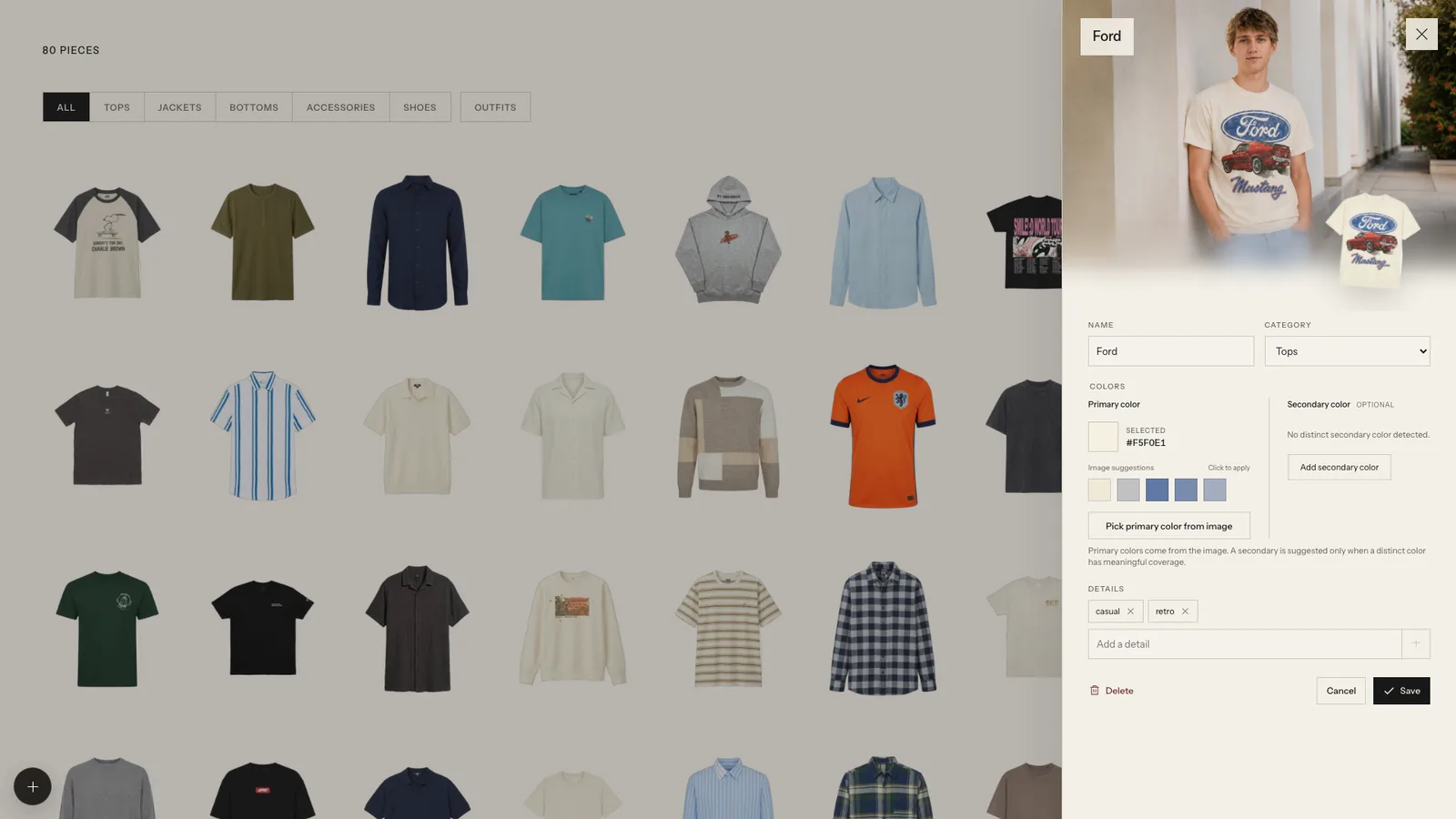
Set up four piles or lists as you go: keep, fix (repair, alter or clean), go, and gaps (things to buy).
The wardrobe audit checklist: six checks
Every piece gets the same six questions. The part-by-part lists below add the specific things to look for.
- Fit. Does it fit now, in the way you like to wear it?
- Condition. Would you wear it in public today, without apologising for it?
- Last worn. When did you last wear it? Within the past year, or within its season for seasonal pieces?
- Duplicates. Do you own something that does the same job, in the same colour, that you reach for first?
- Gaps. Is there something this piece needs to work, such as the right shoes, a layer or a belt, that you do not own?
- Care. Does it need cleaning, de-pilling, polishing, reproofing or storage attention?
A piece that passes the first four goes to keep, with any care work noted. One that fails fit or condition goes to fix or go. Unworn pieces and duplicates need a decision; if you cannot make it, the closet declutter method has a dated maybe box for exactly this.
Tops
- Fit: shoulders sit at the shoulder; buttons do not gape across the chest; sleeves reach the wrist bone or the length you intend; hems are long enough to tuck or sit right untucked.
- Condition: collars and necklines not stretched or rippled; no underarm staining or yellowing; knitwear not heavily pilled or with holes at the elbows; no fading on dark T-shirts beyond what you like.
- Last worn: separate everyday tops from occasion shirts, and judge each group against how often you actually need it.
- Duplicates: sort by colour and count the plain basics. Several near-identical white or black T-shirts are normal; several near-identical patterned shirts usually are not.
- Gaps: check you have tops that go with your most-worn bottoms, and at least one warm layer that fits under your main jacket.
- Care: de-pill knits, replace missing buttons, wash anything that has been sitting.
Jackets and outerwear
- Fit: you can move your arms forward without the back pulling tight; it closes comfortably over the layers you actually wear underneath.
- Condition: zips run smoothly; cuffs and collars are not frayed; linings are intact; waterproofing still beads water off.
- Last worn: outerwear is seasonal, so judge by last season rather than the last month.
- Duplicates: two jackets for the same weather and the same level of formality rarely both get worn.
- Gaps: cover the weather you actually get: something for cold, something for rain, something light. A waterproof and a warm coat are different jobs.
- Care: reproof waterproofs, clean wool coats before storing, and store on shaped hangers so the shoulders keep their form.
Bottoms
- Fit: comfortable sitting down, not just standing; waist does not need a belt pulled to its last hole; length suits the shoes you wear them with.
- Condition: no wear at the inner thigh or at the hems; no bagging at the knees; zips and buttons secure.
- Last worn: be honest about trousers kept for a size you used to be. They belong in go or in a clearly dated maybe.
- Duplicates: several pairs of the same dark jeans in slightly different washes often means one favourite and several backups.
- Gaps: check you have bottoms for each level of formality you need, and at least one pair that goes with most of your tops.
- Care: re-hem, replace buttons, wash inside out to slow fading.
Shoes
- Fit: no rubbing, pinching or heel slip after an hour of walking.
- Condition: soles not worn through or split; heels not worn down at an angle; uppers not cracked; insoles not collapsed.
- Last worn: shoes that hurt tend to go unworn. If you avoid a pair, find out why.
- Duplicates: two pairs of similar everyday trainers are fine if one is kept for wet days; otherwise one is a spare.
- Gaps: check for closed shoes for wet weather, something smart, and something you can walk in all day.
- Care: resole good leather shoes rather than replacing them, polish or condition leather, clean trainers, replace laces.
Accessories
- Fit: belts fasten on a middle hole; hats and gloves fit without stretching.
- Condition: buckles, clasps and straps are sound; scarves not snagged; bags not torn at the handles.
- Last worn: accessories pile up because they are small. Keep the ones that actually complete outfits.
- Duplicates: count belts, scarves and bags by colour. A black belt and a brown belt cover most outfits.
- Gaps: a belt to match each shoe colour you wear with belts; a scarf and gloves for cold days; a bag that goes with most outfits.
- Care: condition leather, repair straps, store scarves folded rather than knotted.
After the audit
Turn the four piles into actions:
| Pile | Action | Deadline |
|---|---|---|
| Keep | Put back by part and colour; update the inventory | Same day |
| Fix | Book repairs, alterations and cleaning | Within two weeks |
| Go | Sell, donate or recycle | Within a week |
| Gaps | Write a short shopping list with colour and what each piece must go with | Before the next purchase |
The gap list is the most valuable output of the audit and the easiest to lose. Keep it somewhere you will see it when shopping, and buy against it rather than browsing. Before you buy, it is worth estimating the cost per wear of each gap item: a piece that fills a real gap will be worn often, which is what makes it good value.
Finally, update your inventory so it matches what is left. The next audit starts from that record rather than from a full wardrobe on the bed, and it takes a fraction of the time.
Questions
Frequently asked questions
- What is the difference between a wardrobe audit and a declutter?
- A declutter decides what leaves. An audit also looks at what is missing, what needs repair or care, and how well the pieces work together, so it produces a to-do list as well as a pile to give away.
- How often should I run a wardrobe audit?
- Twice a year suits most people, usually when seasonal clothes come out of storage. A quick pass on a single part, such as shoes, can be done any time something feels off.
- Do I need an inventory before auditing?
- It helps a great deal, because you can check duplicates and gaps by looking at a list or a photo grid rather than the rail. If you do not have one yet, make it as part of the first audit and the next one will be much faster.
- What should I do with the gaps I find?
- Write them down as a short shopping list, with the part, colour and what the piece has to go with. Buying against that list, rather than browsing, is how the gaps get closed without creating new duplicates.
Related
Keep reading
- Use caseA wardrobe inventory app that counts what you ownUse Outfello as a wardrobe inventory app: log clothes from photos, count pieces per category, spot duplicates by sorting on colour and check your storage cap.
- GuideA closet declutter method that starts with one photoA closet declutter method that starts by photographing everything you own, then sorting by part and colour into keep, maybe and go, with a dated maybe box.
- GuideCost per wear: how to calculate it and use itCost per wear is what a garment costs each time you wear it: price divided by wears. How to calculate it, worked examples, what it changes and where it fails.